“Eco-friendly.” “Green.” “Sustainable.” “Planet-safe.” “Biodegradable.”
These words are everywhere in today’s food and beverage industry. They’re printed in earthy greens and browns, accompanied by leaf icons and recycling symbols. They’re trusted by well-meaning businesses and consumers who are simply trying to do the right thing. But what if we told you that most of these labels mean very little? And the food packaging industry knows it.
How We Are Being Greenwashed
Greenwashing isn’t always a lie. That’s what makes it so effective. It’s usually a half-truth, a claim that is technically accurate in most cases but strategically incomplete, designed to make you feel better about a product without actually changing what it does to the environment.
In food packaging, it shows up in three main ways.
Vague language with no verification
Terms like “eco-friendly,” “green,” and “sustainable” have no legal definition in India and no mandatory certification requirement. Any brand can print them on any product without consequence.
Cherry-picked claims
A cup might be marketed as “made from renewable materials,” which sounds responsible, until you learn it’s still coated in a plastic film that makes it unrecyclable. One fact, used smartly to distract from other uncomfortable ones.
When “biodegradable” Becomes an Issue
Biodegradable is perhaps the most irresponsibly used word in packaging. Almost everything is technically biodegradable, given enough time. A PE-coated paper cup is biodegradable. So is a plastic bag. The question is never just whether something breaks down, but how long it takes, what conditions it needs, and what it actually leaves behind.
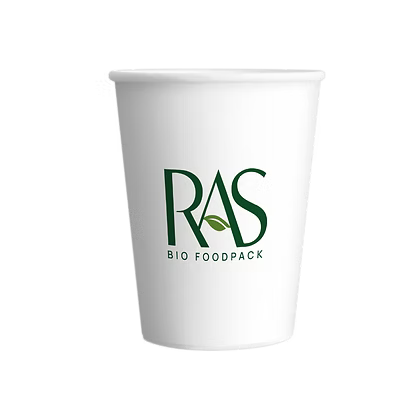
For example, PE-coated paper cups, the standard lining in most disposable cups (Obviously not RAS), can take up to 20 years to break down in a landfill. During that time, the plastic layer releases microplastics into the soil and methane into the atmosphere. So, calling this a biodegradable cup is technically defensible and deeply misleading.
When “compostable” Becomes an Issue
PLA (polylactic acid) and BioPBS (polybutylene succinate) are plant-derived bioplastics increasingly used as cup coatings and marketed as compostable, natural alternatives to PE. But to be certified compostable under ISO 17088, a material must break down with over 90% decomposition within 6 months.
PLA and BioPBS cups can meet this standard, but only under tightly controlled industrial composting conditions like specific temperature, humidity, and microbial environment. And this exists in specialised industrial composting facilities.
In India, those facilities barely exist at scale. So when a PLA-coated cup is thrown away, which is almost always what happens, it ends up in a landfill where it behaves nearly identically to conventional plastic. It doesn’t break down meaningfully but fragments into microplastics.
When “recyclable” Becomes an Issue
Recyclable paper cups face a similar gap between claim and reality. Most disposable paper cups are made of paper fused with a plastic lining, where only the paper itself is recyclable. And separating it from the plastic lining requires an intensive industrial process that very few facilities in India are equipped to handle. So even when a consumer does the right thing and puts the cup in a recycling bin, it almost certainly gets rejected at the facility and ends up in a landfill anyway. The cup was recyclable only in theory.
What Genuine Looks Like
At RAS, we don’t use the word sustainable as decoration. Every claim we make is backed by an independent certifying body, Flustix Europe for plastic-free, CPPRI for repulpable, CIPET for compostable under ISO 17088, US FDA for food safety. If we can’t back it, we don’t say it, let alone market it.